
Short answer: You can often get a personal loan with bad credit, but you will usually pay more and see fewer offers. LendingTree’s third-quarter 2026 offer data puts the average APR at 27.29% for FICO scores of 580 to 669 and 30.18% below 580. A credit union, a co-signer or a smaller loan may lower the cost.
Personal-Loan.com is a free referral service, not a lender; we may be paid by lenders in our network. Each lender decides whether to make an offer and sets the rate, fees and term, and no one can promise approval in advance.
What do lenders mean by bad credit?
Most lenders treat a FICO score below 580 as poor credit and a score of 580 to 669 as fair. Those are the FICO bands Experian published in December 2024. VantageScore uses different labels: 300 to 600 is subprime and 601 to 660 is near prime.
A personal loan for bad credit is an unsecured installment loan made to a borrower with a fair or poor credit score, usually at a higher APR. Your score is only part of the decision. The Consumer Financial Protection Bureau (CFPB) says lenders also weigh your income, other debts, the size and length of the loan, and the rates your state allows. The guide to what counts as a bad credit score covers the bands in detail.
What APR can you expect with fair or poor credit?
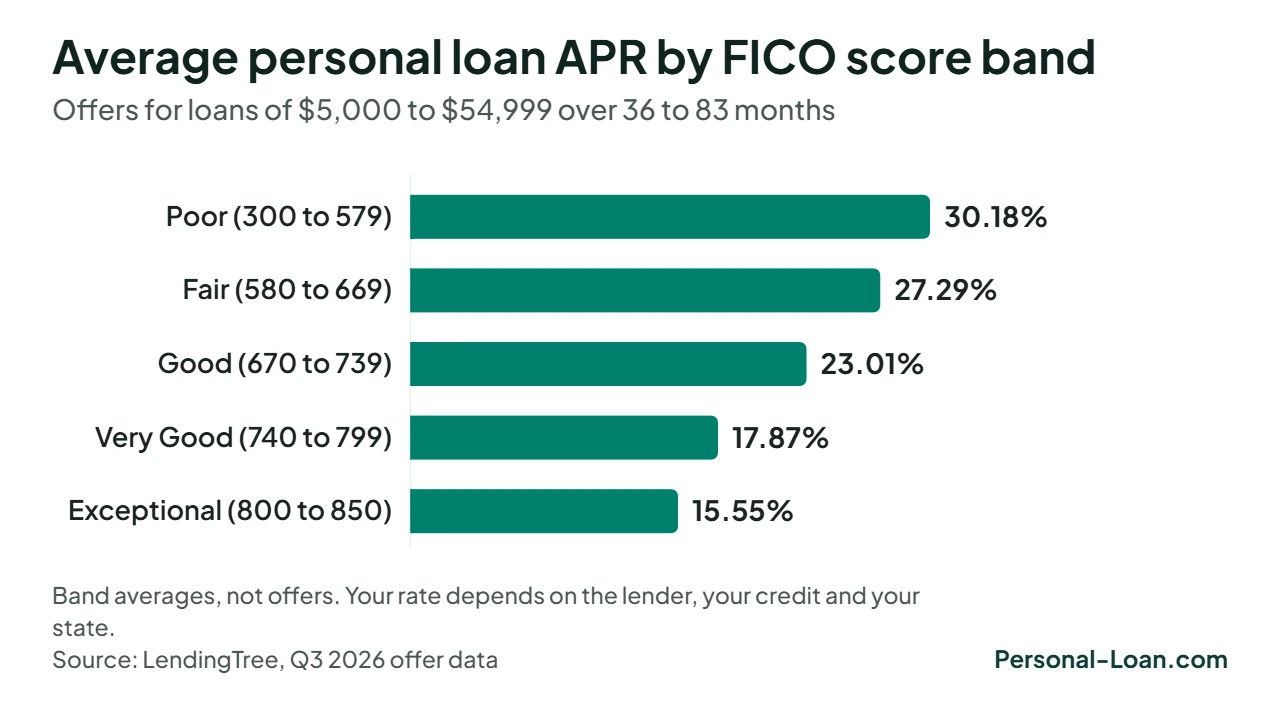
Borrowers with fair or poor credit averaged APRs of about 27% to 30% on LendingTree offers in Q3 2026. In the same data, the average was 23.01% for good credit and 15.55% for exceptional credit.
What to expect in each score band
| FICO score | FICO label | Average offer APR (LendingTree, Q3 2026) | What to expect |
|---|---|---|---|
| 300 to 579 | Poor | 30.18% | Fewer lenders may consider you; Experian (September 2026) says you can get a personal loan with a score of 580 or higher |
| 580 to 669 | Fair | 27.29% | More lenders consider you; origination fees of 1% to 10% are common (Experian) |
| 670 to 739 | Good | 23.01% | A wider choice of lenders and terms (Experian) |
| 740 to 799 | Very Good | 17.87% | Scores above 700 often get the best terms (Experian) |
| 800 to 850 | Exceptional | 15.55% | The lowest average APR in LendingTree’s data |
LendingTree averages cover offers for loans of $5,000 to $54,999 with terms of 36 to 83 months in the third quarter of 2026.
The Federal Reserve’s G.19 release (October 7, 2026) puts the average rate on a 24-month personal loan at commercial banks at 11.90% for August 2026, a preliminary figure. That is a bank benchmark, well below what many online and non-bank lenders charge, so don’t expect it with a low score.
The origination fee is the catch. Many lenders deduct it before paying out, so with a 5% fee you receive 95% of the loan but repay all of it, plus interest. The CFPB describes the APR as the interest rate plus the fees charged with the loan, so compare APRs, not interest rates.
What does a bad credit loan cost?
At the fair-credit average of 27.29% APR, a $3,000 loan repaid in 24 monthly payments costs $163.58 a month and $925.92 in total interest. Example only.
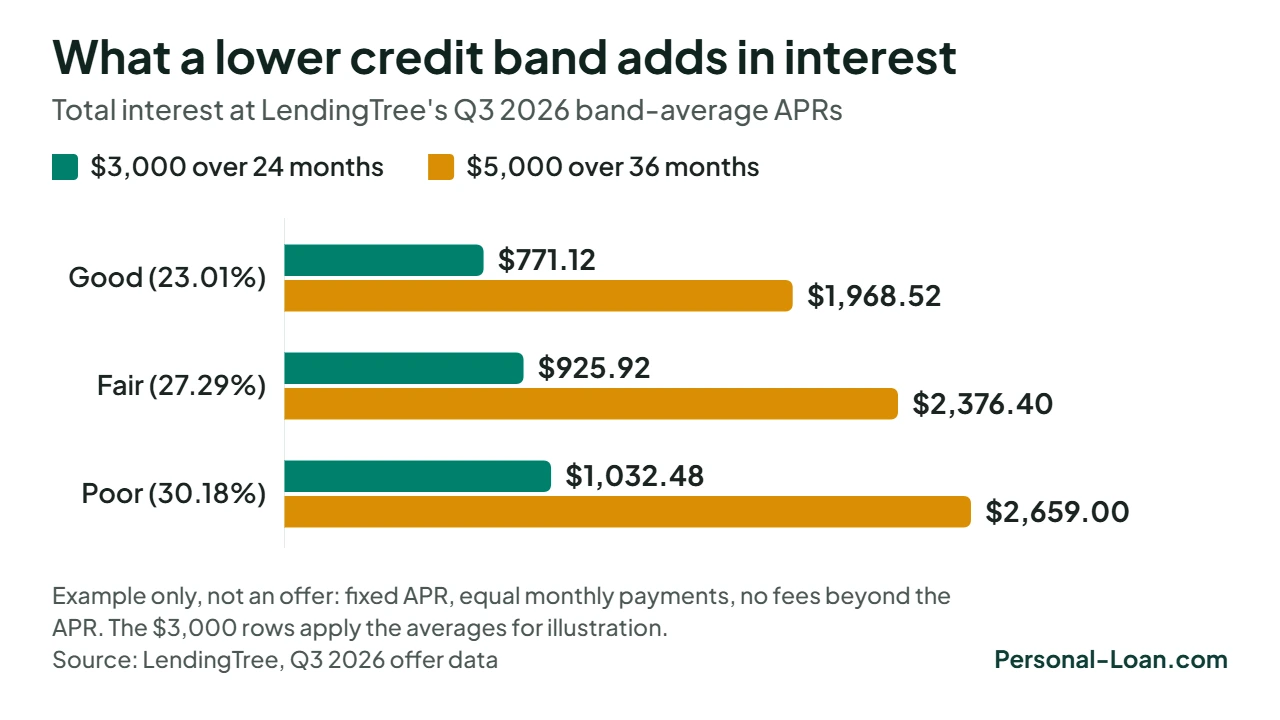
Moving up a band lowers the price. On $5,000 over 36 months, the poor-credit average of 30.18% APR means 36 payments of $212.75 and $2,659.00 in interest. At the good-credit average of 23.01% APR, the payment is $193.57 and interest is $1,968.52, which is $690.48 less. Example only.
| Loan amount | APR | Number of payments | Monthly payment | Total interest | Total repaid |
|---|---|---|---|---|---|
| $3,000 | 23.01% (good) | 24 | $157.13 | $771.12 | $3,771.12 |
| $3,000 | 27.29% (fair) | 24 | $163.58 | $925.92 | $3,925.92 |
| $3,000 | 30.18% (poor) | 24 | $168.02 | $1,032.48 | $4,032.48 |
| $5,000 | 23.01% (good) | 36 | $193.57 | $1,968.52 | $6,968.52 |
| $5,000 | 27.29% (fair) | 36 | $204.90 | $2,376.40 | $7,376.40 |
| $5,000 | 30.18% (poor) | 36 | $212.75 | $2,659.00 | $7,659.00 |
Example only, not an offer. Fixed APR, equal monthly payments made on time, no fees beyond those in the APR. APRs are LendingTree’s Q3 2026 band averages, which cover loans of $5,000 or more over 36 to 83 months; the $3,000 rows apply them for illustration. Try your own numbers in the personal loan calculator.
Can you get a personal loan with a 550 credit score?
Possibly, but expect fewer offers and a high APR. A 550 score sits in FICO’s poor band, where LendingTree’s average offer APR was 30.18% in Q3 2026. Experian says you can get a personal loan with a score of 580 or higher, so a credit union loan, a payday alternative loan, a secured loan or a co-signer may work better.
Which loan options work with lower credit scores?
A credit union loan, a secured loan or a co-signer may cost less than an unsecured loan at a poor-credit rate. Federal credit unions can’t charge more than 18% APR on most loans under a ceiling the National Credit Union Administration (NCUA) extended through September 10, 2027. Their payday alternative loans, small loans meant to replace payday loans, are capped at 28% APR.
| Option | How it works | Cost and limits | Credit needed | The catch |
|---|---|---|---|---|
| Online lender loan for fair or poor credit | Unsecured installment loan with fixed monthly payments | Average APR 27.29% (580 to 669) and 30.18% (under 580), LendingTree Q3 2026; fees of 1% to 10% are common (Experian) | Experian: possible from 580 | The costliest mainstream option; the fee often comes out of the money you receive |
| Federal credit union personal loan | Loan from a member-owned credit union | APR capped at 18% on most loans through September 10, 2027 (NCUA) | Set by each credit union | You have to become a member first, and approval isn’t automatic |
| Payday alternative loan (PAL I or PAL II) | Small loan from a federal credit union, repaid in installments | PAL I: $200 to $1,000 over 1 to 6 months. PAL II: up to $2,000 over 1 to 12 months. Up to 28% APR; application fee no more than $20 | Set by each credit union | PAL I needs one month of membership; no rollovers; three PALs at most in six months |
| Secured personal loan | Backed by savings, a certificate of deposit or a vehicle | Generally lower rates than unsecured loans (Experian) | Generally easier to qualify for (Experian) | You could lose the collateral if you can’t keep up with payments |
| Co-signer or co-borrower | A person with stronger credit applies with you | May help you qualify for better terms (Experian) | The lender also weighs the other person’s credit | A co-signer may have to pay the full debt plus late fees (Federal Trade Commission, FTC) |
| Credit-builder loan | The lender holds the money while you repay, usually over 6 to 24 months, then releases it (CFPB) | Varies by lender | Made for people building or rebuilding credit | No cash now; it builds a payment record and savings |
A $2,000 PAL II at the 28% APR maximum, repaid in 12 monthly payments of $193.01, costs $316.12 in interest. Example only. NCUA’s consumer site explains the rules for payday alternative loans, which are set out in 12 CFR 701.21.
Can you get a personal loan with no credit check?
Rarely, because most personal loan lenders check your credit before making an offer. The CFPB lists credit history among the main things installment lenders review. Be wary of offers that skip the credit check: the FTC warns that a lender who doesn’t care about your credit history and promises a loan may be running a scam.
The same applies here: if you submit a request through Personal-Loan.com, lenders may check your credit with one or more credit bureaus.
Will checking your options hurt your credit score?
It can, if a lender runs a hard inquiry. FICO says one additional inquiry takes less than five points off most people’s scores, and it affects FICO scores for one year.
Lenders in the Personal-Loan.com network may check your credit with one or more credit bureaus, so ask each lender how it checks before you apply.
What are the red flags with bad credit loan offers?
The clearest warning sign is a promise of approval or a request for money up front. The FTC says legitimate lenders “won’t promise or guarantee you a loan or credit before you apply.”
Watch for three patterns:
- A guarantee of approval. Scam ads use lines like “Bad credit? No problem,” according to the FTC.
- A fee before you get the loan, often called insurance, processing or paperwork. Under the Telemarketing Sales Rule, the FTC says it is illegal for telemarketers to promise you a loan and ask you to pay for it up front. The FTC’s guide to advance-fee loan scams explains how to report one at ReportFraud.ftc.gov.
- A push toward a car title loan. In its 2016 study of single-payment auto title loans, the CFPB found that one in five borrowers had their car or truck seized or repossessed, and the typical APR was about 300%.
Payday loans cost far more: the CFPB says a common fee of $15 per $100 on a two-week loan works out to an APR of almost 400%.
How can you improve your approval odds and your rate?
A clean credit report, lower debts and a smaller request give lenders fewer reasons to decline, and can move you into a cheaper band.
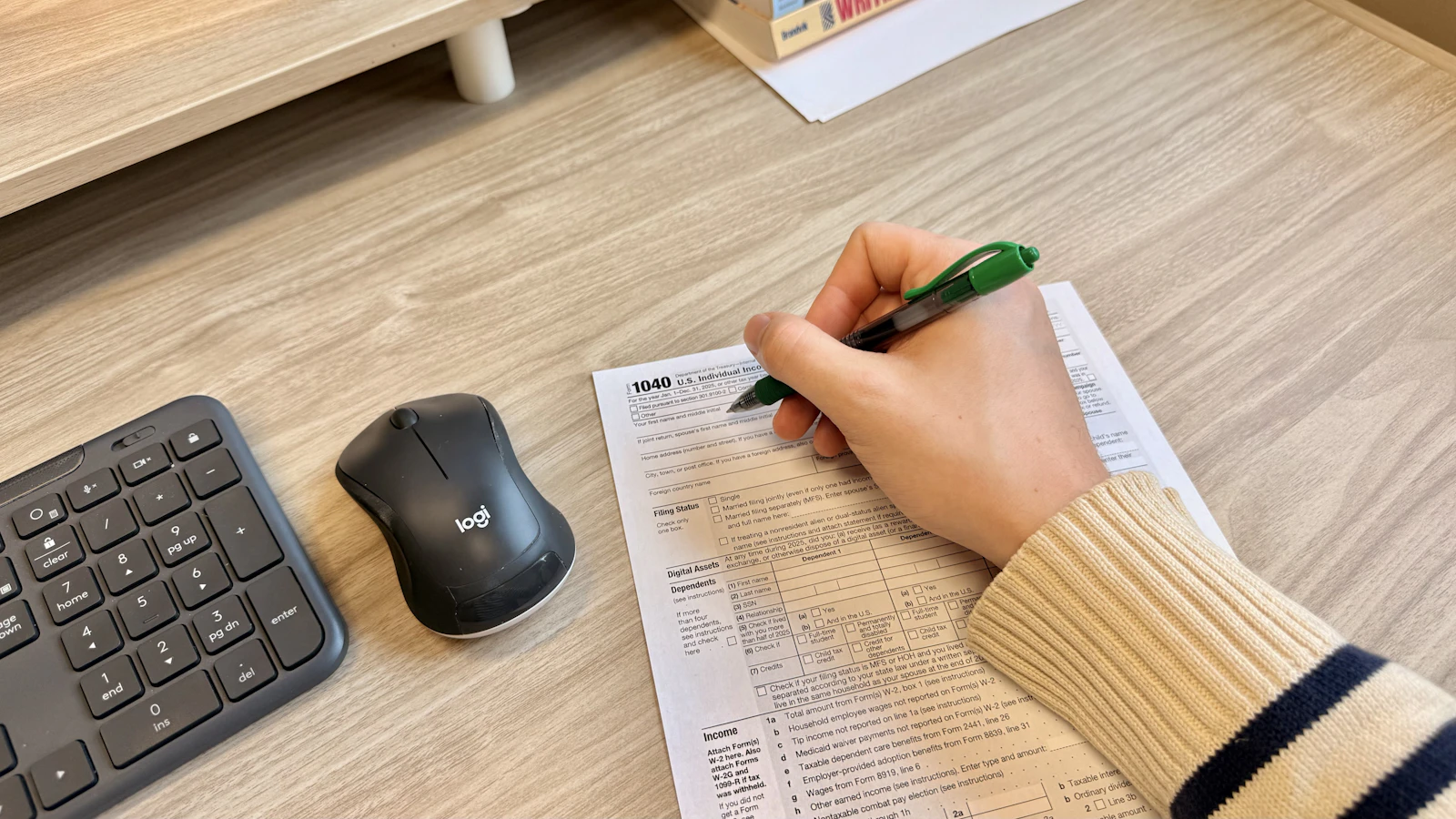
- Check your credit reports for errors. You can get free reports from Equifax, Experian and TransUnion once a week at AnnualCreditReport.com, according to the CFPB. Dispute any account or late payment that isn’t yours.
- Lower your debt-to-income ratio. Debt-to-income (DTI) is your monthly debt payments divided by your gross monthly income. Experian says many lenders prefer a DTI below 36%. The guide to personal loan requirements covers the income, documents and other checks lenders use.
- Ask for less: a smaller loan means a smaller payment and less interest.
- Add a co-signer or collateral, if everyone involved understands what they could lose.
- Compare APRs and total cost, not the monthly payment. A longer term lowers the payment but adds interest. The personal loan terms glossary defines each term you will see in an offer.
- Wait, if the expense can wait. In the cost example above, moving from the poor band to the good band saves $690.48 in interest on a $5,000, 36-month loan.
What limits does the law put on bad credit loan rates?
State law caps the APR on personal installment loans in most states, though the cap depends on the state and the loan size. The National Consumer Law Center’s survey of state laws (December 2025) found that 43 states and DC cap the APR on a $2,000, two-year loan, with a median cap of 34%. The table of personal loan rate caps by state shows the limits where you live.
What the law says: The Military Lending Act caps the Military APR at 36% on most consumer loans to active-duty servicemembers and their covered dependents (32 CFR 232.4(b)).
The CFPB says that cap counts interest, most fees, credit insurance and add-on products.
When you’re ready, you can send one request to lenders in our network and compare the APR and total cost of any offer before you accept.
More bad credit loan questions
Can a lender guarantee approval for a bad credit loan?
No legitimate lender can guarantee approval before reviewing your application. The FTC lists approval guarantees and “bad credit, no problem” promises as signs of an advance-fee scam, especially when a fee is due before you get the money.
How fast can I get a bad credit loan?
Lenders may fund as soon as the next business day after approval, but timing depends on the lender and your bank, and no one can promise it. Read the APR and fees before you sign.
Can a personal loan help rebuild my credit?
It can, if the lender reports to the credit bureaus and you pay on time. A credit-builder loan is made for this: you repay first and get the money at the end, the CFPB explains.
Bad credit personal loans at a glance
| Item | Figure | Source |
|---|---|---|
| Average offer APR, FICO 580 to 669 (fair) | 27.29% | LendingTree, Q3 2026 |
| Average offer APR, FICO below 580 (poor) | 30.18% | LendingTree, Q3 2026 |
| Average 24-month personal loan rate at commercial banks | 11.90% for August 2026 (preliminary) | Federal Reserve G.19, October 7, 2026 |
| Credit score for a personal loan | Experian says you can get a personal loan with a score of 580 or higher | Experian, September 2026 |
| Origination fees | 1% to 10% are common | Experian |
| Debt-to-income ratio many lenders prefer | Below 36% | Experian |
| Federal credit union APR ceiling | 18% on most loans, through September 10, 2027 | NCUA |
| Payday alternative loans (PAL I and PAL II) | Up to 28% APR; application fee no more than $20; PAL I $200 to $1,000, PAL II up to $2,000 | NCUA, 12 CFR 701.21 |
| Military APR cap for active-duty servicemembers and covered dependents | 36% on most consumer loans | Military Lending Act, 32 CFR 232.4(b) |
| State APR caps on a $2,000, two-year loan | 43 states and DC; median cap 34% | National Consumer Law Center, December 2025 |
| Effect of one additional hard inquiry | Less than five points for most people; affects FICO scores for one year | FICO |
| Payday loan, $15 per $100 for two weeks | APR of almost 400% | CFPB |
| Single-payment auto title loans | Typical APR about 300%; one in five borrowers had their car or truck seized or repossessed | CFPB, 2016 study |
Updated November 2026. This page is general information, not financial or legal advice.