
Short answer: To get a personal loan, most lenders require that you are at least 18, live in a state they serve, have a Social Security number and a U.S. bank account, and show regular income. Many accept credit scores from about 580, according to Experian, and many prefer a debt-to-income ratio below 36%.
Personal-Loan.com is a free referral service, not a lender; we may be paid by lenders in our network. Each lender sets its own requirements and makes its own credit decision.
What do you need to get a personal loan?
You need proof of who you are, proof of income, and a credit profile the lender accepts. Personal loan requirements are the minimum conditions a lender sets before it will consider your application: age, residency, credit, income, existing debt and identity. The Consumer Financial Protection Bureau (CFPB) says most lenders weigh your credit score and reports, income, debts, the amount and length of the loan, the interest rates your state permits, and sometimes your bank account transactions (CFPB, last reviewed August 30, 2024). No single factor decides the outcome.
Age: 18 or the age of majority in your state
You must be old enough to sign a binding contract, which is 18 in most states. Upgrade says applicants must be at least 18, or older where the state’s age of majority is higher. SoFi asks that you be at least the age of majority in your state.
Residency and citizenship status
Lenders ask about citizenship because federal rules let them. Regulation B, which carries out the Equal Credit Opportunity Act, allows a creditor to ask about an applicant’s permanent residency and immigration status (12 CFR 1002.5(e)). Policies differ. Upgrade accepts U.S. citizens, permanent residents and people on a valid visa, and SoFi accepts some non-permanent residents with current immigration documents. You must also live in a state where the lender can lend.
A bank account
Online lenders deposit the money in a bank account and usually collect payments from it. Upstart asks for a personal account at a U.S. financial institution with a routing number. Happen Bank and Upgrade ask for verifiable bank account information.
Identification
You need a Social Security number and government-issued ID. Under the federal Customer Identification Program rule (31 CFR 1020.220), banks must collect at least your name, date of birth, address and an identification number before they open an account. Experian says a driver’s license or Social Security card is typically enough to prove identity.
What is the minimum credit score for a personal loan?
There is no single minimum credit score; it depends on the lender. Many lenders accept scores from about 580, and a score above 700 often qualifies for the best terms, according to Experian (updated September 25, 2026). Few lenders publish a hard cutoff.
Among the lenders on this page, Best Egg has a 600 minimum, according to Credible, and Upstart publishes no formal minimum. The page on what credit score you need for a personal loan shows how each score band changes the price.
What APR can you expect at your credit score?
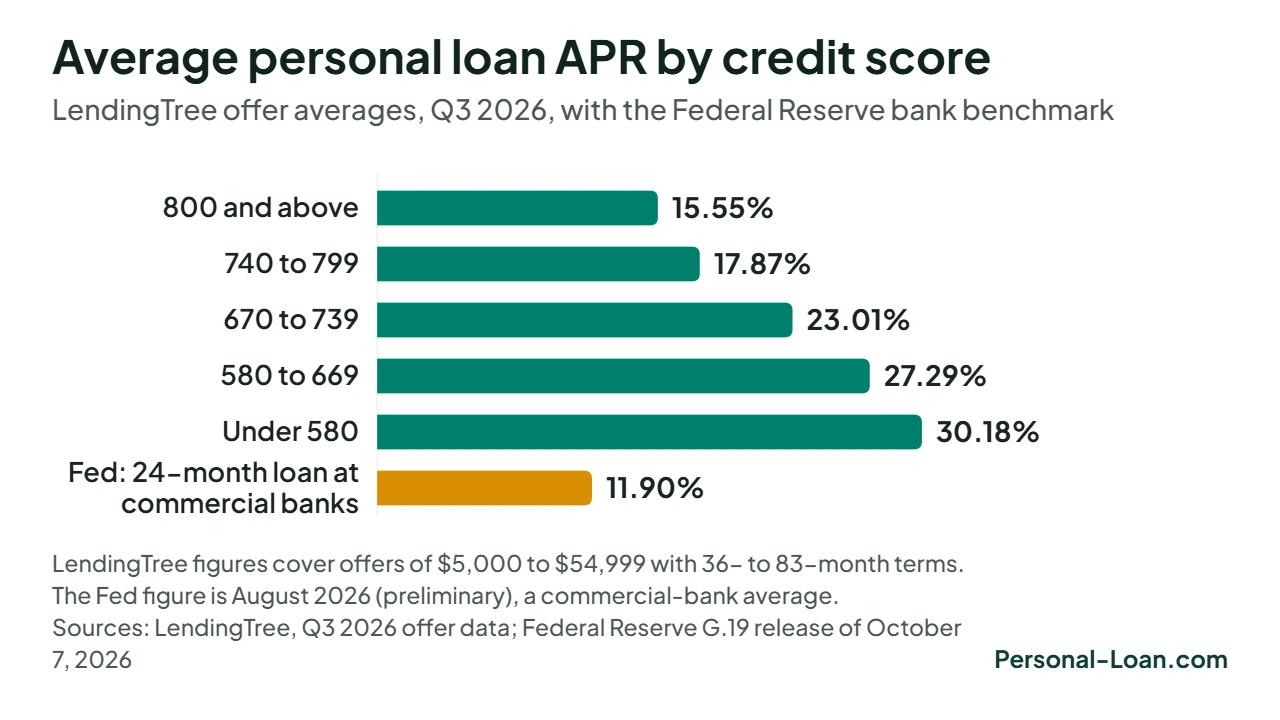
The lower your credit band, the higher the average APR. The average APR on personal loan offers ranged from 15.55% to 30.18% by credit band in the third quarter of 2026, according to LendingTree’s data on offers of $5,000 to $54,999 with 36- to 83-month terms.
| Credit score band | Average APR on offers (LendingTree, Q3 2026) |
|---|---|
| 800 and above | 15.55% |
| 740 to 799 | 17.87% |
| 670 to 739 | 23.01% |
| 580 to 669 | 27.29% |
| Under 580 | 30.18% |
Federal Reserve benchmark: 11.90% average on a 24-month personal loan at commercial banks, August 2026 (preliminary), G.19 release of October 7, 2026.
The Federal Reserve figure is a commercial-bank average, well below what many online lenders charge. State law also limits rates. The National Consumer Law Center found that 43 states and DC cap the APR on a $2,000, two-year loan, with a median cap of 34% (December 19, 2025); the personal loan rate caps by state page lists the rules. Active-duty servicemembers and covered dependents are protected by the Military Lending Act, which caps the Military APR at 36% (32 CFR 232.4(b)).
To see what lenders in our network may offer, the personal loan request form sends one request to several of them. Submitting it does not guarantee a loan, and lenders may check your credit. Check the APR, fees and total repayment in any offer before you accept.
How much income do you need for a personal loan?
Some lenders set a dollar minimum, and many do not publish one. Upstart sets a minimum of $12,000 a year, and Discover requires at least $25,000 in individual or household income. Other lenders weigh your income against your debts instead of using a fixed floor. Lenders want regular, verifiable income, not necessarily a salaried job.
Can you get a personal loan without a job?
Yes, if you have other regular income the lender can verify. Upstart accepts a full-time job, a regular part-time job, a job offer starting within six months, or another regular source of income. SoFi accepts sufficient income from other sources, or a job offer within 90 days. Lenders still check that you can afford the payment.
What debt-to-income ratio do you need for a personal loan?
Experian says lenders generally prefer a debt-to-income ratio below 36%, though many approve higher ratios. The CFPB defines debt-to-income ratio (DTI) as all your monthly debt payments divided by your gross monthly income.
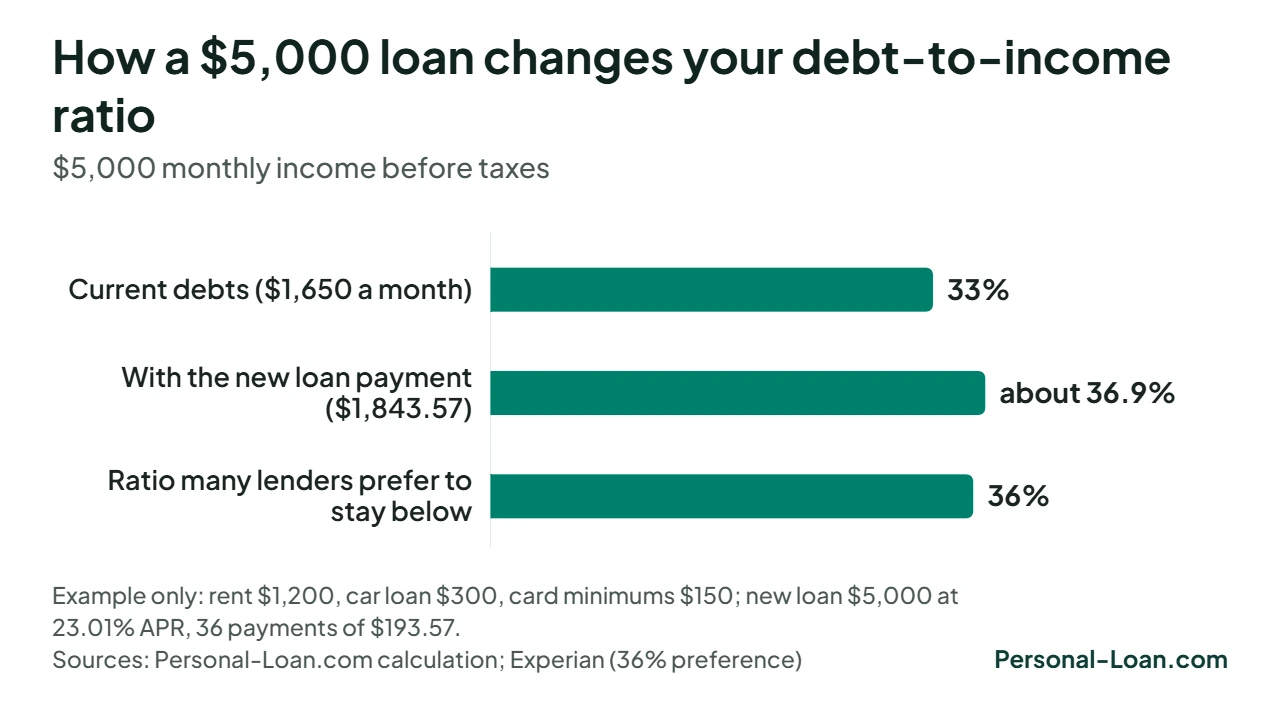
Example only: you earn $5,000 a month before taxes and pay $1,200 in rent, $300 on a car loan and $150 in card minimums. That is $1,650 in debt, a DTI of 33%. A $5,000 loan at 23.01% APR repaid in 36 monthly payments of $193.57 (total interest about $1,969) raises your monthly debt to $1,843.57 and your DTI to about 36.9%. A payment that pushes you past 36% may lead to a smaller offer or a decline. The personal loan calculator shows the payment for your own numbers.
What do well-known online lenders publish as minimums?
Most large online lenders do not publish a minimum credit score, income or DTI on their own sites. Personal-Loan.com checked the personal loan pages and eligibility pages of eight lenders on November 3, 2026. “Not published” means the figure did not appear on the lender’s pages we checked. This table compares published rules only; it does not mean any of these lenders is in the Personal-Loan.com network.
| Lender | Minimum credit score | Minimum income | Maximum DTI | Other published requirements |
|---|---|---|---|---|
| Upstart | None published; must meet lending partners’ requirements | $12,000 a year | Not published | 18+; verifiable SSN; U.S. bank account; job, job offer within 6 months, or other regular income |
| Best Egg | 600 FICO (per Credible, October 16, 2026; not stated on Best Egg’s loan page) | Not published | Not published | Not published beyond the factors it weighs (score, income, debts, credit history) |
| Happen Bank (formerly LendingClub) | Not published | Not published | Not published | 18+; U.S. citizen or resident; verifiable bank account |
| Avant (loans issued by WebBank) | Not published | Not published | Not published | Terms depend on credit, state law and other factors |
| Upgrade | Not published | Not published | Not published | 18+ (older where state law requires); U.S. citizen, permanent resident or valid visa; bank account and email |
| SoFi | Not published | Not published | Not published | Age of majority; citizen, permanent resident or documented non-permanent resident; income or job offer within 90 days |
| Discover (part of Capital One) | Not published | $25,000 individual or household | Not published | Over 18; valid U.S. SSN |
| OneMain Financial | Not published | Not published | Not published | Proof of identity, residence and income before closing |
| Lender | Loan amounts | APR range | Origination fee | Terms | States not served or state limits |
|---|---|---|---|---|---|
| Upstart | $1,000 to $75,000 | 6.3% to 35.99% | Range not published | 3 or 5 years | Higher minimums in GA ($3,100), HI ($1,500), MA ($7,000) |
| Best Egg | $2,000 to $50,000 | 6.99% to 35.99% | 0.99% to 9.99% | 36 to 60 months | Not available in IA, NE, VT, WV, DC or U.S. territories |
| Happen Bank (formerly LendingClub) | $1,000 to $75,000 | 5.96% to 35.99% | 0% to 8% | 24 to 84 months | All states and DC; no U.S. territories |
| Avant | $2,000 to $35,000 | 9.95% to 35.99% | Administration fee up to 9.99% | 24 to 60 months | Minimums vary by state; some states not accepted (not listed on the page checked) |
| Upgrade | $1,000 to $50,000 | 7.74% to 35.99% | 1.85% to 9.99% | 24 to 84 months | Some offers not available in all states |
| SoFi | $5,000 to $100,000 | Not published | Not published | Not published | Must live where SoFi is authorized to lend; higher minimums in some states |
| Discover | $2,500 to $40,000 | 6.99% to 24.99% | None | 36 to 84 months | State restrictions may apply |
| OneMain Financial | $1,500 to $35,000 | 11.99% to 35.99% | $25 to $500 flat, or 1% to 10% | 24 to 60 months | State minimums (e.g. CA $3,000) and maximums (e.g. NC $11,000) |
Source: each lender’s own personal loan and eligibility pages, checked November 3, 2026, except the Best Egg score (Credible, updated October 16, 2026). Listing a lender does not mean it is in the Personal-Loan.com network. Lenders change criteria without notice; check the lender’s site before you apply.
The catch is the fee. An origination fee is a charge for making the loan, usually taken out of the money you receive, and Experian puts the common range at 1% to 10%. Example only: a $5,000 loan with a 5% fee and a 20% interest rate, repaid in 36 monthly payments of $185.82, puts $4,750 in your account. You pay about $1,689 in interest plus the $250 fee, so the APR is about 23.8%, not 20%. Because the APR includes the fee, it is the number to compare.
What documents do you need for a personal loan application?
Expect to give identity, income and housing details on the application, and some lenders ask for paperwork later to verify them.

- Government-issued photo ID, such as a driver’s license, and your Social Security number
- Proof of address, such as a utility bill or lease (OneMain asks for proof of residence before closing)
- Proof of income: recent pay stubs, W-2s or tax returns; Upgrade lists all three
- Your employer’s name and contact details, plus consent to verify employment
- Your monthly rent or mortgage payment
- Bank account and routing numbers for the deposit
- For consolidation, balances of the debts you plan to pay off
What do lenders check beyond your credit score?
Your full credit report counts, not just the score: lenders may look at late payments, how much of your card limits you use, how long you have had credit and how often you have applied recently. The CFPB adds that some lenders look at bank account transactions, and OneMain lists bankruptcy history and your state of residence among its factors. A smaller amount or shorter term may be approved when a larger request is not. The personal loan terms glossary explains words like APR, origination fee and hard inquiry.
What should you do if your personal loan application is denied?
Start with the adverse action notice, because it tells you why you were turned down. If the lender used your credit report, the notice must give the score it used, the key factors behind it, and the credit bureau’s contact details. You can get a free copy of that report within 60 days of the notice and dispute any errors (CFPB, last reviewed December 31, 2024).
What the law says: Under Regulation B (12 CFR 1002.9), a lender must tell you its decision within 30 days of receiving a completed application, and a denial must come in writing with the specific reasons or instructions for requesting them.
The Equal Credit Opportunity Act bars lenders from discriminating based on race, color, religion, national origin, sex, marital status, age (if you are old enough to contract), receipt of public assistance income, or exercising your rights under consumer credit law. If you believe that happened, you can file a complaint with the CFPB or the Federal Trade Commission (FTC).
Before you reapply, fix what the notice names or ask about a co-borrower. SoFi asks you to wait at least 30 days. Never pay a fee up front to someone who promises you a loan; the FTC says it is illegal for telemarketers to promise a loan and ask you to pay for it first. If credit is the obstacle, see personal loans for bad credit.
What can a personal loan be used for, and what costs less?
At most lenders, almost any personal use is allowed, but a cheaper option often exists for the common ones.
| Purpose | What to know | Cheaper option to check first |
|---|---|---|
| Debt consolidation | Saves money only if the new APR, fee included, is lower and old balances stay paid off | A debt management plan from a nonprofit credit counselor, which the CFPB says usually lowers payments, interest and fees |
| Medical bills | Ask the provider about a payment plan or a reduced bill before you borrow | The hospital’s financial assistance policy: tax-exempt hospitals must have a written one under IRS section 501(r)(4) |
| Car repair | Lender minimums often start at $1,000 to $2,500 | A credit union loan: federal credit unions are limited to 18% on most loans through September 10, 2027, and 28% on payday alternative loans (NCUA, February 2026) |
| Home improvement | Unsecured, so your home is not collateral; funds arrive as one lump sum | A home equity loan or line of credit, which may cost less because the home secures it, though you could lose the home if you cannot repay |
| Moving | Costs are known ahead, so borrow only the gap | Several written estimates, savings, or relocation help from an employer |
More personal loan requirements FAQs
Can a prequalified personal loan still be denied?
Yes. A prequalified offer is based on the details you entered and usually a soft credit check, so the lender can still decline or change the terms after it verifies your income, identity and full credit report.
Does submitting a request on Personal-Loan.com affect my credit?
It depends on the lender. Lenders in our network may check your credit with one or more credit bureaus, and FICO says one hard inquiry takes less than five points off most people’s scores. Ask the lender which type of check it uses before you accept a formal application.
Personal loan requirements at a glance
| Requirement | What lenders commonly look for | Published figures on this page |
|---|---|---|
| Age | 18, or the age of majority in your state | Upstart, Happen Bank and Upgrade: 18+; Discover: over 18; SoFi: age of majority |
| Residency | Live in a state the lender serves; citizenship or immigration status may be asked (12 CFR 1002.5(e)) | Upgrade accepts a valid visa; SoFi accepts documented non-permanent residents |
| Credit score | Many lenders accept from about 580; above 700 often gets the best terms (Experian) | Best Egg: 600 FICO (per Credible); Upstart: no formal minimum |
| Income | Regular, verifiable income, not necessarily a salaried job | Upstart: $12,000 a year; Discover: $25,000 individual or household |
| Debt-to-income ratio | Generally below 36% (Experian); many approve higher | Not published by any of the eight lenders checked |
| Bank account and ID | A U.S. bank account, a Social Security number and government-issued ID | Banks must collect at least your name, date of birth, address and an ID number before they open an account (31 CFR 1020.220) |
| APR by credit band | Average APR on offers, LendingTree, Q3 2026 | 15.55% (800 and above) to 30.18% (under 580) |
Updated November 2026. This page is general information, not financial or legal advice.