
Short answer: A debt consolidation loan saves money only when its APR, fees included, is below your cards’ rate and you stop adding to the cards. Example only: $8,000 at 22.36% APR paid at $300 a month takes 38 months and $3,163.08 in interest, while 36 payments of $279.48 on an $8,000 loan at 15.55% APR cost $2,061.28.
Personal-Loan.com is a free referral service, not a lender; we may be paid by lenders in our network. Lenders set the rate, fees and term of any offer, and submitting a request does not guarantee a loan.
What is a debt consolidation loan?
A debt consolidation loan is a personal loan you use to pay off several debts, usually credit cards, so you make one fixed payment instead of many. The Consumer Financial Protection Bureau (CFPB) describes it as a way to repay your separate loans and pay back just one amount. Most are unsecured personal loans with a fixed rate, a fixed monthly payment and an end date.
A credit card works differently: the minimum payment moves with the balance, and the rate is often variable. The CFPB warns that a low rate on a consolidation offer may be a teaser rate that lasts only a limited time, and that a longer repayment period can cost you more overall. The personal loan terms glossary explains APR, term and origination fee if an offer uses words you don’t know.
How does a debt consolidation loan work?
You take one loan, use it to pay off your balances, then repay it in equal monthly payments, so every payment is the same until the loan is paid off.
- List each debt with its balance, APR and minimum payment, so you know the rate the loan has to beat.
- Compare offers by APR and total cost, not by monthly payment. Lenders may check your credit with one or more credit bureaus. The guide to personal loan requirements covers what lenders look at.
- Choose how the money is paid out. Experian (May 2026) says some lenders will pay your creditors directly if you give them each account’s details and payoff amount. Otherwise the money goes to your bank account and you pay each creditor yourself. Pay the cards right away so new interest doesn’t build.
- Confirm that every card shows a zero balance before you close any account, as Experian advises.
- Repay the loan on schedule.
Is a debt consolidation loan worth it?
Consolidating is worth it when the loan’s APR, fees included, is clearly lower than your cards’ APR, the term is about as short as your current payoff, and you stop using the cards. In the example below ($8,000 of card debt, example only), the break-even APR is about 23.1% over 36 months.
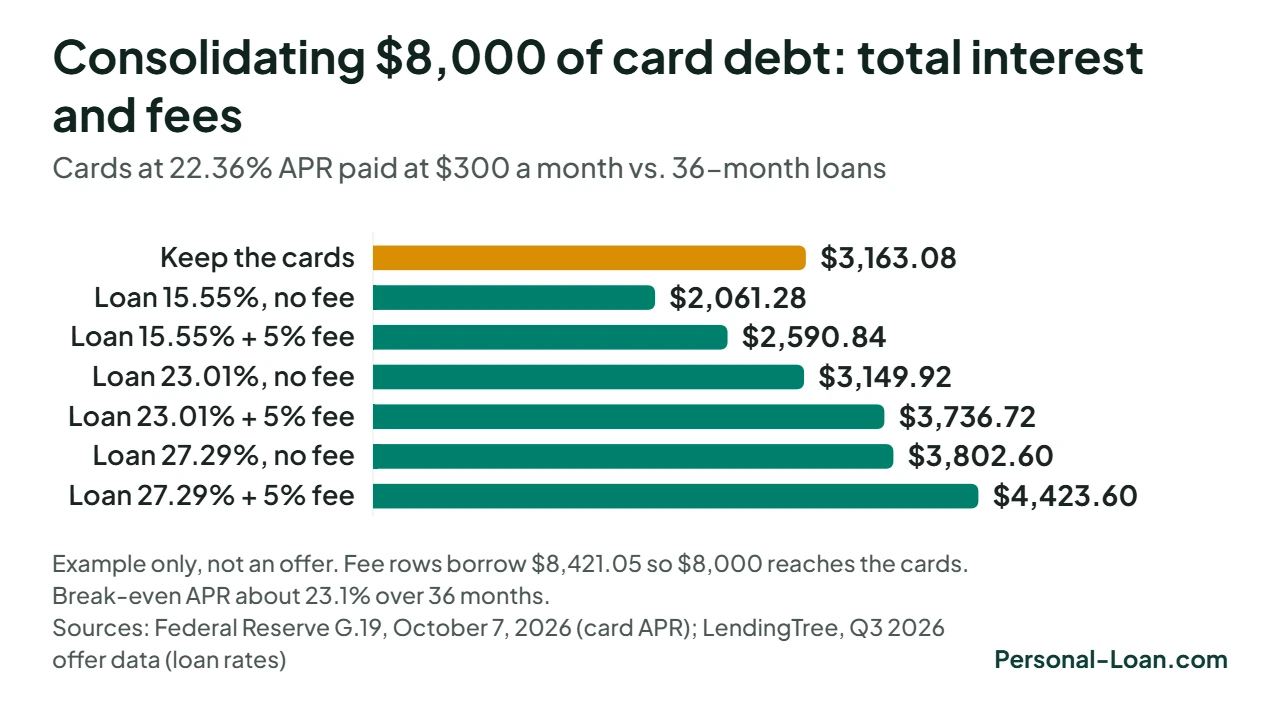
Take $8,000 of card debt at 22.36% APR, the Federal Reserve’s average for credit card accounts that were charged interest in August 2026 (G.19 release, October 7, 2026). Paying $300 a month with no new charges, you clear it in 38 payments (37 of $300 and a final $63.08) and pay $3,163.08 in interest. The loans below use 15.55%, 23.01% and 27.29%, LendingTree’s average offer APRs in Q3 2026 for credit scores of 800 and up, 670 to 739, and 580 to 669.
The fee rows treat those same figures as the loan’s interest rate and add a 5% origination fee taken out of the loan. To get $8,000 to the cards, you would borrow $8,421.05, and the $421.05 fee pushes the APR above the interest rate. A 15.55% loan with that fee has an APR of 19.23%.
| Option | Interest rate | APR | Monthly payment | Number of payments | Total interest and fees | Compared with the cards |
|---|---|---|---|---|---|---|
| Keep the cards, pay $300 a month | 22.36% | 22.36% | $300 (last one $63.08) | 38 | $3,163.08 | Baseline |
| Loan, no fee | 15.55% | 15.55% | $279.48 | 36 | $2,061.28 | $1,101.80 less |
| Loan, 5% fee | 15.55% | 19.23% | $294.19 | 36 | $2,590.84 | $572.24 less |
| Loan, no fee | 23.01% | 23.01% | $309.72 | 36 | $3,149.92 | $13.16 less |
| Loan, 5% fee | 23.01% | 26.86% | $326.02 | 36 | $3,736.72 | $573.64 more |
| Loan, no fee | 27.29% | 27.29% | $327.85 | 36 | $3,802.60 | $639.52 more |
| Loan, 5% fee | 27.29% | 31.25% | $345.10 | 36 | $4,423.60 | $1,260.52 more |
Example only, not an offer. Fee rows borrow $8,421.05 so that $8,000 reaches the cards after a $421.05 fee. Card interest is figured monthly at a fixed 22.36% APR with no new purchases; card issuers may figure interest daily, so real totals can differ slightly. All loan payments are made on time. Run your own numbers in the personal loan calculator.
The break-even rule: compare APR with APR
In this example, the break-even point is an APR of about 23.1% over 36 months. Below it, the loan costs less than the cards; above it, the loan costs more. The rule holds with or without a fee, because the APR already counts the fee: a loan at about 19.3% interest with a 5% fee has an APR of about 23.1% and lands at the same cost as the cards. A borrower with fair credit is the hard case. LendingTree’s fair-credit average of 27.29% APR sits above the Fed’s 22.36% card average, so at that score a consolidation loan may cost more than the debt it replaces.
When doesn’t debt consolidation help?
A new loan doesn’t help when its APR isn’t lower than your cards’, a fee eats the savings, or the cards fill up again.
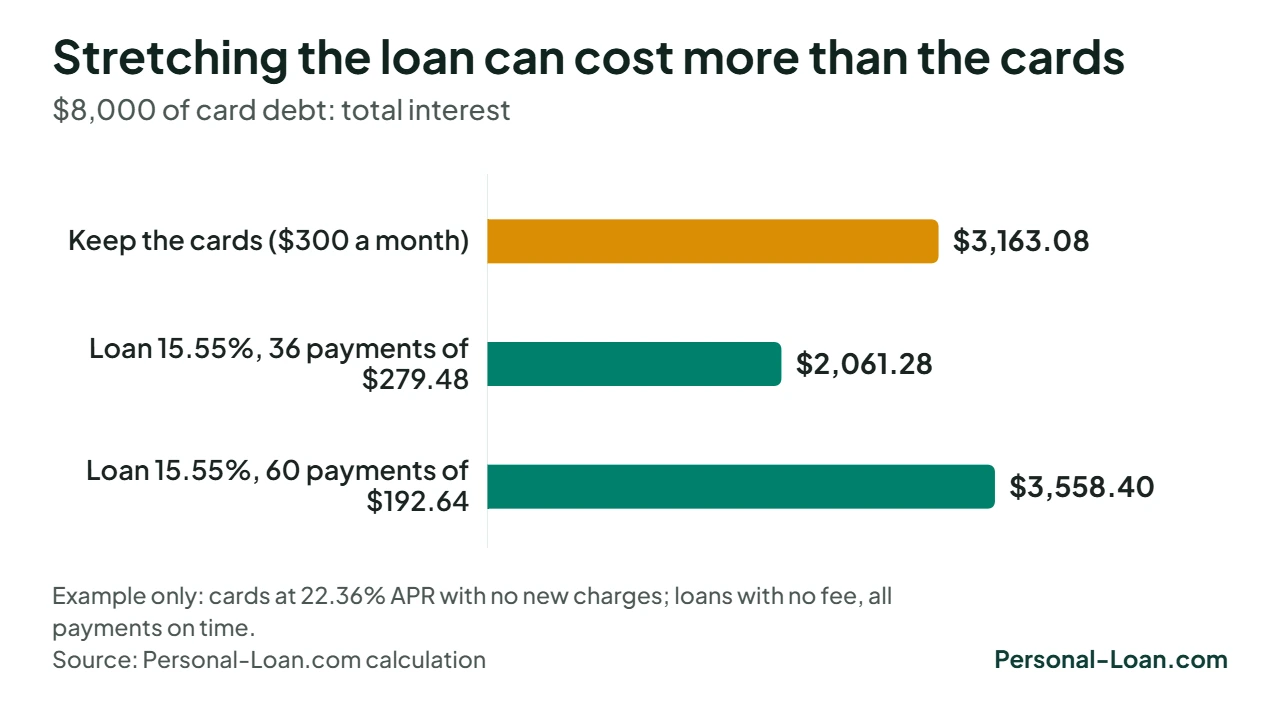
Here is how each case plays out in the example above ($8,000, 36 monthly payments, example only):
- A higher rate. At 27.29% APR with no fee, the loan costs $639.52 more than paying the cards.
- A fee. A 5% fee turns the 23.01% loan from roughly even into $573.64 more expensive, because its APR rises to 26.86%.
- A longer term. The same 15.55% APR loan stretched to 60 monthly payments of $192.64 costs $3,558.40 in interest, $395.32 more than the cards, even though the payment is lower. Example only.
- New card balances. If you keep using the cards after paying them off, you end up with the loan payment and card bills at once.
What credit score do you need for a debt consolidation loan?
Many lenders start at about 580, according to Experian, but a low score may not get a rate worth taking. LendingTree’s average offer APR for scores of 580 to 669 was 27.29% in Q3 2026, above the Federal Reserve’s 22.36% average for card accounts charged interest in August 2026.
Lenders also look at income and debt-to-income ratio. The guide to what counts as a bad credit score shows the FICO bands lenders use.
Does a debt consolidation loan hurt your credit score?
If the lender runs a hard credit check, expect a small dip, then possible gains as your card balances fall. FICO says one additional hard inquiry takes less than five points off most people’s scores; inquiries stay on your report for up to two years but count in FICO scores for one year.
Paying your cards off entirely with a loan could help your credit utilization, the share of your card limits you’re using, according to Experian (September 2026). On-time loan payments help over time, and late ones hurt.
In most cases, don’t close the paid-off cards right away. Experian suggests keeping old cards open at least until the balances are paid down, because closing them can raise your credit utilization. First confirm each card shows a zero balance.
What are the alternatives to a debt consolidation loan?
A 0% balance transfer, a nonprofit debt management plan or a call to your creditors may cost less than a loan. Each has a trade-off.

| Option | How it works | Typical cost | Main risk |
|---|---|---|---|
| 0% balance transfer card | Move card balances to a card with a 0% promotional rate | Transfer fee typically 3% to 5% of the amount moved (Experian, September 2026); the CFPB confirms a fee can apply on a 0% offer | Any balance left when the promotion ends is charged the card’s regular APR; you need good enough credit to qualify |
| Debt management plan (DMP) | You make one payment a month to a nonprofit credit counseling agency, which pays your creditors (CFPB) | Counselors may charge fees; get a written quote (CFPB; Federal Trade Commission, FTC). Creditors may lower rates or waive fees (FTC) | A plan can take 48 months or more (FTC); some DMP organizations have defrauded people, so confirm your creditors accepted the plan (CFPB) |
| Home equity loan or HELOC | Borrow against the value of your home | May include points, where one point is 1% of the amount borrowed (FTC) | If you can’t make the payments, or pay late, you could lose your home (FTC) |
| Talk to your creditors | Call before a debt collector is involved and ask for a lower rate or a payment plan you can manage (FTC) | No new loan | The creditor can say no |
The CFPB suggests starting with the National Foundation for Credit Counseling or the Financial Counseling Association of America to find a counselor, and checking the agency with your state attorney general. Its page on credit counseling, debt settlement and debt consolidation sets out the differences. A cash-out refinance is a different product: it replaces your mortgage with a bigger one secured by your home, often with closing costs, according to the CFPB.
Why be careful with debt settlement companies?
Settlement firms usually tell you to stop paying your creditors while they negotiate, the CFPB says, and that can add fees and interest and further damage your credit. The CFPB also says these firms cannot erase all your debts.
The FTC says a debt settlement company can’t collect its fees before it settles your debt.
What the law says: Under the Telemarketing Sales Rule, 16 CFR 310.4(a)(5), a debt relief company may not collect a fee until it has settled or changed the terms of at least one debt and you have made at least one payment under that agreement.
The FTC adds that you might not finish the program and that forgiven amounts could count as taxable income. Its guide on how to get out of debt compares settlement with the other options.
Is there a legal limit on what a consolidation loan can cost?
Many states cap personal loan APRs, and the cap depends on the state and loan size; see personal loan rate caps by state. The Military Lending Act caps the Military APR at 36% for active-duty servicemembers and covered dependents (32 CFR 232.4(b)).
When you are ready to compare real offers, you can submit one request to lenders in our network and check the APR and total cost in each offer before you accept.
Debt consolidation loans at a glance
| Item | Figure on this page | Source |
|---|---|---|
| Average card APR, accounts charged interest, August 2026 | 22.36% | Federal Reserve G.19, October 7, 2026 |
| Average offer APR, credit scores of 800 and up | 15.55% | LendingTree, Q3 2026 |
| Average offer APR, credit scores of 670 to 739 | 23.01% | LendingTree, Q3 2026 |
| Average offer APR, credit scores of 580 to 669 | 27.29% | LendingTree, Q3 2026 |
| $8,000 of card debt at $300 a month | 38 payments, $3,163.08 in interest | Example only |
| $8,000 loan at 15.55% APR, 36 months | $279.48 a month, $2,061.28 in interest | Example only |
| 5% origination fee on that loan | Borrow $8,421.05; APR 19.23% | Example only |
| Break-even APR, 36 months | About 23.1% | Example only |
| Credit score many lenders start at | About 580 | Experian |
| One additional hard inquiry | Less than five points for most people; counts in FICO scores for one year | FICO |
| Balance transfer fee | Typically 3% to 5% of the amount moved | Experian, September 2026 |
| Debt management plan length | Can take 48 months or more | FTC |
| Military Lending Act cap | 36% Military APR | 32 CFR 232.4(b) |
Example only, not an offer: the example rows repeat the worked example above. Lenders set the rate, fees and term of any offer.
Updated November 2026. This page is general information, not financial or legal advice.