
Short answer: This personal loan glossary explains, in plain English, 113 terms you’ll see in US loan offers, disclosures and contracts, and names the federal rule behind a term wherever one exists. If you’re comparing offers, five terms matter most: APR, interest rate, origination fee, term and total cost of the loan.
Each entry opens with a plain definition and then says why the term matters when you borrow. When a law or regulation defines the term, such as Regulation Z for APR or the Military Lending Act for the military APR, the entry names it in a short clause. We checked the definitions against the Consumer Financial Protection Bureau (CFPB), the FTC, the Federal Reserve, the eCFR and the credit scoring companies in November 2026. Personal-Loan.com is a free referral service, not a lender; we may be paid by lenders in our network.
Which personal loan terms matter most when you compare offers?
To compare personal loan offers, look at the APR, the term, the fees and the total cost. The APR includes interest and most lender fees, so it is the best single number for comparing offers with the same term. The term sets your monthly payment and how much interest you pay overall. An origination fee comes out of the money you receive. The total cost shows in dollars what the loan costs you. Lenders must put all of these in the Truth in Lending disclosure, which you get before you sign.
| Term | What it tells you | Where to find it |
|---|---|---|
| APR | Yearly cost of the loan, including interest and most fees | Truth in Lending disclosure, “Annual percentage rate” |
| Interest rate | Yearly charge for borrowing the principal, before fees | Loan offer and loan agreement |
| Origination fee | One-time fee, often deducted from the money you get | Loan offer; it is counted in the finance charge |
| Term | How many months you have to repay | Payment schedule |
| Total cost of the loan | All interest and fees, in dollars | “Finance charge” and “Total of payments” |
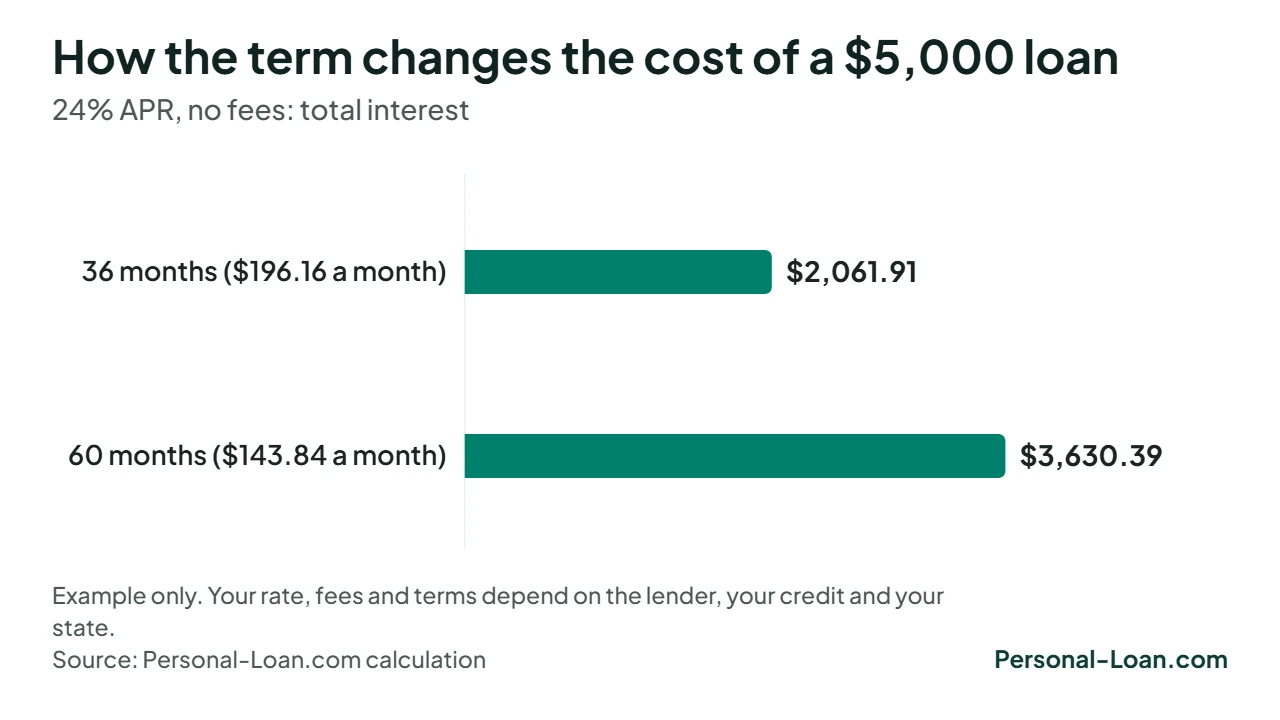
Example only: $5,000 repaid in 36 monthly payments of $196.16 at 24% APR, with no fees, costs $2,061.91 in interest, for a total of payments of $7,061.91. Your rate, fees and terms depend on the lender, your credit and your state.
A
- Adverse action notice
- An adverse action notice is the notice a lender must send when it turns down your application or offers you materially worse terms than you asked for, and you don’t accept them. Regulation B, which implements the Equal Credit Opportunity Act, generally gives the lender 30 days after it receives a completed application to notify you, and the notice must state the main reasons or tell you how to ask for them. If a credit report played a part, the Fair Credit Reporting Act adds more: the notice must name the credit bureau, disclose the credit score used, say that the bureau did not make the decision, and tell you that you can dispute the report and get a free copy if you ask within 60 days.
- Advance-fee loan scam
- An advance-fee loan scam is a fake loan offer that asks you to pay a fee before you get any money, often calling it insurance, processing or paperwork. The FTC says it’s illegal for telemarketers to promise you a loan and ask you to pay for it up front, and it flags payment by wire transfer, gift card or cryptocurrency as warning signs. A real lender lists its fees, such as an origination fee, in the loan terms and usually deducts them from what you receive.
- Amortization
- Amortization is paying off a loan in scheduled installments that each cover some interest and some principal. Early payments go mostly to interest because the balance is at its highest. Example only: on $5,000 repaid in 36 monthly payments of $196.16 at 24% APR, about $100 of the first payment is interest and $96.16 is principal.
- Amortization schedule
- An amortization schedule is a table that shows every payment, how it splits between interest and principal, and the balance left after it. Use one to see how much of each payment goes to interest and how fast the balance falls.
- Amount financed
- The amount financed is the credit you actually receive or that is paid out for you, after any prepaid finance charges are subtracted. Regulation Z requires lenders to disclose it with a description such as “the amount of credit provided to you or on your behalf.” If a lender deducts a $500 origination fee from a $10,000 loan, the amount financed is $9,500.
- Annual percentage rate (APR)
- The annual percentage rate (APR) is the yearly cost of a loan, including interest and most lender fees, stated as a percentage. Regulation Z defines it as “a measure of the cost of credit, expressed as a yearly rate”, and both lenders and advertisers have to use the term “annual percentage rate.” Because the APR includes fees such as an origination fee, it is the best single number for comparing offers with the same term.
- Application fee
- An application fee is a charge for processing your request, whether or not you’re approved. Under Regulation Z, a fee charged to every applicant, approved or not, is not part of the finance charge, so it may not show up in the APR. Under the Military Lending Act, though, application fees count toward the 36% cap for covered borrowers, with a narrow exception for some small loans from credit unions and banks.
- Arbitration clause
- An arbitration clause is a contract term that sends disputes to a private arbitrator instead of a court, and it often waives your right to join a class action. Some loan agreements let you opt out in writing within a set number of days after you sign, so read that section of the loan agreement before you sign.
- Autopay discount
- An autopay discount is a lower rate that some lenders give if you agree to automatic payments from your bank account. Regulation E bars a lender from making automatic electronic payments a condition of the loan, but it may reward autopay with a lower APR as long as it also offers the loan without autopay. Check whether the APR on your offer already assumes the discount.
- Average personal loan rate
- The average personal loan rate is a market benchmark, and the number depends on whose loans are counted. The Federal Reserve’s G.19 release of October 7, 2026 put the average rate on 24-month personal loans at commercial banks at 11.90% for August 2026 (preliminary), a bank figure well below what many online lenders charge. LendingTree’s Q3 2026 offer data, covering loans of $5,000 to $54,999 over 36 to 83 months, shows average APRs from 15.55% for scores of 800 and up to 30.18% for scores under 580.
B
- Balance transfer
- A balance transfer moves debt from one credit card to another, usually to get a 0% promotional APR for a set period. The CFPB describes a balance transfer fee as “a fee charged to transfer an outstanding balance to a different credit card,” and it is typically a percentage of the amount you move. Any balance left when the promotion ends is charged the card’s regular rate, so compare that rate with a fixed-rate debt consolidation loan.
- Balloon payment
- A balloon payment is a final payment much larger than the regular installments. The CFPB describes personal installment loans as repaid in fixed amounts on a set schedule, so a balloon would be unusual. Check the payment schedule in your Truth in Lending disclosure to be sure.
- Bank partnership lending
- Bank partnership lending is an arrangement in which a bank makes the loan and a non-bank company markets it, services it or buys it or an interest in it. It matters because the bank’s home-state rate rules may apply in place of your state’s rate cap (see rate exportation). Some states have challenged these arrangements, arguing that the non-bank is the “true lender,” so whether a given loan is lawful can depend on the state and the facts.
- Bankruptcy
- Bankruptcy is a federal court process that can wipe out or reorganize your debts. For individuals it usually means Chapter 7 (liquidation) or Chapter 13 (a repayment plan). The CFPB says a bankruptcy can stay on your credit report for up to 10 years, so treat it as the most drastic option and talk to a nonprofit credit counselor or a bankruptcy attorney first.
- Broker (loan broker)
- A loan broker is a person or company that arranges a loan between you and a lender, sometimes for a fee you pay, and some states license or regulate them. A broker that wants payment before you get any loan is a warning sign (see advance-fee loan scam). Personal-Loan.com charges borrowers nothing; see lead generator.
C
- Charge-off
- A charge-off is a lender’s decision to write off an unpaid debt as a loss, typically after 120 to 180 days of missed payments, according to Experian. A charged-off loan is not forgiven: you still owe it, and the lender may keep collecting or sell the debt to a collector. Experian says a charge-off can stay on your credit report for up to seven years from the first missed payment.
- Closed-end credit
- Closed-end credit is a loan for a set amount that you repay over a fixed term and can’t draw on again, such as a personal installment loan or a car loan. Regulation Z defines it as any consumer credit that is not open-end credit, and its closed-end disclosure rules are the ones that apply to most personal loans. Compare revolving credit.
- Co-borrower (joint loan)
- A co-borrower is a second applicant who shares the loan and the legal duty to repay it; a loan with two co-borrowers is a joint loan. The lender can weigh both incomes and both credit histories, and the loan usually appears on both credit reports. Unlike a co-signer, a co-borrower usually has a right to the loan money too.
- Co-signer
- A co-signer is someone who agrees to repay your loan if you don’t, without getting any of the money. The FTC’s Credit Practices Rule requires lenders under its jurisdiction to give a co-signer a written notice before they become liable, and it begins: “You are being asked to guarantee this debt. Think carefully before you do.” If you miss payments, they can show up on the co-signer’s credit record as well as yours.
- Collateral
- Collateral is property you pledge to back a loan, such as a savings account, a certificate of deposit or a car title. If you default, the lender can take it, which is why a secured loan may cost less than an unsecured loan.
- Collections
- Collections is the stage when an overdue debt is pursued by the lender’s collection team, a collection agency or a debt buyer. Under the CFPB’s Regulation F, a third-party debt collector is presumed to follow the rule against repeated calls only if it calls you about a debt no more than seven times in seven days, and not within seven days after a phone conversation with you about it. The CFPB says most negative information, including collection accounts, can stay on your credit report for seven years.
- Consumer Financial Protection Bureau (CFPB)
- The Consumer Financial Protection Bureau (CFPB) is the federal agency that writes and enforces rules under federal consumer financial laws, including Regulation Z (truth in lending), Regulation B (equal credit) and Regulation F (debt collection). You can submit a complaint about a lender, servicer or debt collector to the CFPB through consumerfinance.gov.
- Credit bureau
- A credit bureau is a company that collects information about how you use credit and sells it as credit reports; the Fair Credit Reporting Act calls it a consumer reporting agency. The three nationwide credit bureaus are Equifax, Experian and TransUnion. A lender may check one, two or all three, and the reports can differ, so review all three.
- Credit-builder loan
- A credit-builder loan is a small loan in which the lender holds the money in a savings account or certificate of deposit while you make the payments, then releases it to you at the end. Experian says the lender reports your payments to the three major credit bureaus, which can build a payment history. It suits someone with a thin credit file who can afford the payments, not someone who needs cash now.
- Credit counseling
- Credit counseling is a service, usually from a nonprofit agency, that reviews your budget and debts and may offer a debt management plan. The FTC warns that nonprofit status doesn’t guarantee the service is free or affordable, so get any fees in writing before you sign up.
- Credit freeze
- A credit freeze blocks most new creditors from seeing your credit report until you lift it, which helps stop identity thieves from opening accounts in your name. The FTC says it costs nothing to place or lift a freeze, and a freeze doesn’t affect your credit score. If your reports are frozen, lift the freeze at each bureau before you apply for a loan.
- Credit history
- Credit history is the record of how you have borrowed and repaid, as shown in your credit reports: your accounts, balances, on-time and late payments, and how long each account has been open. FICO says length of credit history makes up about 15% of a FICO Score.
- Credit insurance
- Credit insurance is optional coverage sold with some loans that makes your payments or pays off the balance if you die, become disabled or lose your job, depending on the policy. Regulation Z lets a lender leave the premium out of the finance charge and the APR only if the coverage is voluntary, that fact and the premium are disclosed in writing, and you sign or initial a request for it. For covered servicemembers, the Military Lending Act counts the premiums toward the 36% cap.
- Credit mix
- Credit mix is the range of credit types in your reports, such as installment loans, credit cards and a mortgage. FICO says credit mix counts for about 10% of a FICO Score, so it is rarely a good reason on its own to take out a loan.
- Credit report
- A credit report is a statement of your credit activity and current credit situation, compiled by a credit bureau. The FTC says the three nationwide bureaus have permanently extended a program that lets you check your report from each one once a week, free, at AnnualCreditReport.com. If you find an error, dispute it; the CFPB says the companies that supplied the information generally must investigate and respond within 30 days.
- Credit score
- A credit score is a number, usually between 300 and 850, that predicts how likely you are to repay on time, based on your credit reports; the CFPB calls it “a prediction of your credit behavior.” The two main brands are the FICO Score and VantageScore. You have many scores, not one, because each model and each bureau’s data produce a different number. See what counts as a bad credit score for a personal loan.
- Credit union
- A credit union is a member-owned, not-for-profit financial institution, and you usually have to join before you can borrow. The NCUA has extended a temporary 18% interest rate ceiling on most federal credit union loans through September 10, 2027. Payday alternative loans are the exception, at up to 28%.
- Credit utilization
- Credit utilization is the share of your available revolving credit that you are using; $3,000 in balances on $10,000 of card limits is 30% utilization. It falls under “amounts owed,” which FICO says makes up about 30% of a FICO Score, and VantageScore 4.0 weights utilization at 20%. Paying off cards with an installment loan can lower utilization, but only if you don’t run the balances back up.
- Creditor
- A creditor is the person or company that extends the credit and to whom the debt is first owed. Regulation Z defines a creditor as someone who regularly extends consumer credit that carries a finance charge or is repayable in more than four installments, and to whom the obligation is initially payable. A lead generator or broker that passes your request along is not the creditor.
D
- Debt consolidation
- Debt consolidation is combining several debts, often credit cards, into one new loan or account with a single payment. It saves money only if the new APR, fees included, is lower than what you pay now and you don’t build up new balances. Compare a consolidation loan, a balance transfer and a debt management plan in the debt consolidation loan guide.
- Debt management plan
- A debt management plan is a repayment plan arranged by a credit counseling agency: you make one monthly deposit, and the agency pays your unsecured creditors, who may lower rates or waive some fees. The FTC says a plan can take 48 months or more, you may have to stop using new credit, and secured debts such as car loans aren’t included.
- Debt settlement
- Debt settlement is negotiating with creditors to accept less than the full balance, usually through a for-profit company while you stop paying and save money in a dedicated account. The FTC’s Telemarketing Sales Rule bars debt relief companies that sell by phone from charging fees until they have settled at least one debt and you have made a payment under the deal. The FTC also warns that the missed payments can hurt your credit, creditors may sue, and forgiven debt may count as taxable income.
- Debt-to-income ratio (DTI)
- Debt-to-income ratio (DTI) is all your monthly debt payments divided by your gross monthly income, as the CFPB defines it. For example, $1,500 in monthly debt payments on $5,000 of gross monthly income is a 30% DTI. Experian (September 25, 2026) says lenders prefer a DTI below 36%, though many approve higher ratios; see personal loan requirements.
- Default
- Default is failing to meet the terms of your loan agreement, usually by missing payments, as the agreement defines it. After a default the lender may demand the full balance, add fees the contract and state law allow, send the account to collections or sue. The loan agreement says when an account counts as in default.
- Deferment
- Deferment is a lender-approved postponement of one or more payments, usually by moving them to the end of the loan. On a personal loan, interest typically keeps building during the deferment, so the total cost goes up. Ask before you miss a payment, and get the terms in writing.
- Delinquency
- Delinquency is the status of a loan with a payment past due. According to Experian, a payment is reported to the credit bureaus as late once it is a full 30 days past due. The CFPB says most negative information can stay on your report for seven years.
- Direct payment to creditors
- Direct payment to creditors is a debt consolidation option in which the lender sends some or all of the loan money straight to your credit card companies or other creditors instead of to you. It removes a step, and you never hold money you might be tempted to spend. Keep paying the old accounts until each one shows as paid off.
- Disbursement
- Disbursement is the release of the loan money, usually by direct deposit to your bank account. You receive the loan amount minus any origination fee the lender deducts (see amount financed).
E
- Equal Credit Opportunity Act (ECOA)
- The Equal Credit Opportunity Act (ECOA) is the federal law that bars lenders from discriminating against credit applicants; the CFPB implements it through Regulation B. Under Regulation B, a lender may not treat you differently because of race, color, religion, national origin, sex, marital status, or age (if you are old enough to sign a contract), or because you receive public assistance income or have used your rights under consumer credit laws in good faith. The ECOA is also where your right to an adverse action notice comes from.
F
- Fair Credit Reporting Act (FCRA)
- The Fair Credit Reporting Act (FCRA) is the federal law that governs credit bureaus and the companies that use and supply credit report information. It gives you the right to dispute inaccurate information and limits how long most negative items can be reported. It also requires a notice when a lender uses your report to deny you or charge you more (see adverse action notice and risk-based pricing notice).
- Finance charge
- The finance charge is the cost of the credit in dollars: interest plus most fees the lender charges as a condition of the loan. Regulation Z defines it as “the cost of consumer credit as a dollar amount,” including interest, loan fees such as origination fees, and credit report fees. A fee for an unexpected late payment is not part of it.
- FICO Score
- A FICO Score is a credit score from the company FICO, and its base versions run from 300 to 850. FICO says the score weighs payment history (35%), amounts owed (30%), length of credit history (15%), new credit (10%) and credit mix (10%). Experian lists the FICO bands as poor (300-579), fair (580-669), good (670-739), very good (740-799) and exceptional (800-850).
- Fixed rate
- A fixed rate is an interest rate that stays the same for the life of the loan, so your payment doesn’t change. The CFPB describes personal installment loans as repaid in fixed amounts on a set schedule. Regulation Z requires the lender to disclose a variable-rate feature if the loan has one (see variable rate).
- Forbearance
- Forbearance is a temporary pause or reduction in payments that a lender agrees to, usually during a hardship. Interest generally keeps building, and you may have to repay the skipped amounts later as a lump sum, through extra payments or over a longer term. Ask exactly how repayment will work before you agree.
- Fraud alert
- A fraud alert is a note on your credit reports that tells lenders to take extra steps to confirm your identity before opening credit in your name. The FTC says an initial fraud alert lasts one year and can be renewed, and an extended fraud alert for identity theft victims lasts seven years. A fraud alert doesn’t block access to your report the way a credit freeze does.
- Funding time
- Funding time is how long the money takes to reach your account after you accept a loan. Some lenders fund as soon as the next business day after approval, depending on the lender and your bank. No one can promise a date before you’re approved and have signed.
G
- Garnishment
- Garnishment is a legal order that makes your employer send part of your pay to a creditor, most often after the creditor sues and wins a judgment. For ordinary debts, such as a defaulted personal loan, the U.S. Department of Labor says federal law caps weekly garnishment at whichever is less: 25% of your disposable earnings, or the amount by which those earnings exceed 30 times the federal minimum wage ($217.50 a week at $7.25 an hour). Some states set lower limits.
- Grace period
- A grace period on a personal loan is a set number of days after the due date when you can still pay without a late fee. Not every loan has one; your loan agreement or Truth in Lending disclosure says whether yours does and how long it lasts.
- Gross income
- Gross income is your income before taxes and other deductions. The CFPB’s debt-to-income ratio definition uses gross monthly income, which is how lenders usually calculate it. Compare net income.
H
- Hard inquiry
- A hard inquiry is a credit check a lender makes when you formally apply for credit, and it shows on your credit report. FICO says one extra inquiry takes less than five points off most people’s FICO Scores, affects the score for a year, and stays on the report for up to two years. FICO also groups multiple hard inquiries made within a short shopping period (14 to 45 days, depending on the score version) into one, but its examples are mortgage, auto and student loans, and it doesn’t say whether personal loans are treated the same way.
- Hardship program
- A hardship program is a lender’s temporary arrangement for borrowers dealing with job loss, illness or another setback, such as a lower payment, a deferment or forbearance. Programs differ by lender, and none is guaranteed. Call before you miss a payment, and ask how the change will be reported to the credit bureaus.
- Home equity loan and HELOC
- A home equity loan is a lump-sum loan secured by your home, and a home equity line of credit (HELOC) is a revolving line secured the same way. The rate may be lower than on an unsecured personal loan, but you could lose your home if you can’t repay. Because these loans are secured by your principal dwelling, Regulation Z generally gives you a three-business-day right of rescission.
I
- Income verification
- Income verification is the lender’s check that you earn what you reported. It may use pay stubs, W-2s, tax returns, bank statements or, with your permission, a direct connection to your bank account.
- Installment loan
- An installment loan is a loan you get as a lump sum and repay in fixed amounts on a set schedule, which is how the CFPB describes a personal installment loan. Car loans and mortgages are installment loans too. Credit cards are revolving credit.
- Interest
- Interest is the price you pay to borrow money, charged as a percentage of the unpaid principal. On a personal loan it is part of the finance charge, along with most fees.
- Interest rate
- The interest rate is the yearly percentage a lender charges on the principal, not counting fees. The CFPB puts the difference this way: the interest rate is “the cost you pay to the lender for borrowing money,” and the APR is “the interest rate plus any additional fees charged by the lender.” When a loan has an origination fee, its APR is higher than its interest rate.
J
- Judgment
- A judgment is a court’s ruling that you owe a debt, usually after a creditor or debt collector sues you. Depending on state law, it can let the creditor garnish your wages or put a lien on property. Don’t ignore a court summons, even for a debt you dispute.
L
- Late fee
- A late fee is a charge for a payment that arrives after the due date or grace period. Regulation Z requires the lender to disclose any late charge before you sign, and state law may cap it. Late fees are not part of the finance charge, so they aren’t reflected in the APR.
- Lead generator (loan matching service)
- A lead generator, also called a loan matching or referral service, collects your loan request and passes it to one or more lenders, who may pay it for the referral; it is not a lender and doesn’t make the credit decision, set rates or fees, or fund the loan. Personal-Loan.com works this way: we pass your request to lenders in our network, and each lender sets its own terms and may check your credit. Before you submit a request on any such site, read the consent language and the privacy policy, which say who may contact you.
- Lender
- A lender is the bank, credit union or licensed finance company that approves the loan, sets its terms and provides the money. The FTC says your state attorney general or banking regulator can confirm whether a lender is registered in your state.
- Lien
- A lien is a legal claim on property that backs a debt, and it gives the creditor the right to take or sell the property if you don’t pay. A secured loan puts a lien on the collateral. A creditor with a court judgment may also be able to place a lien on your property, depending on state law.
- Line of credit
- A personal line of credit is revolving credit you can draw on up to a limit, repay and draw again, paying interest only on what you use. Many lines of credit carry a variable rate. A personal installment loan, by contrast, pays out once.
- Loan agreement (promissory note)
- A loan agreement, or promissory note, is the contract in which you promise to repay the loan on stated terms. Regulation Z uses the word “consummation” for the moment you become contractually obligated, and the lender must give you the Truth in Lending disclosure before that point. Read the sections on fees, default, arbitration and autopay before you sign.
- Loan amount
- The loan amount is the principal you borrow, before any fee is deducted. The Personal-Loan.com request form takes amounts from $100 to $35,000, and what a lender offers depends on the lender, your credit and income, and state law. Borrow only what you need, since a larger loan costs more in interest.
- Loan purpose
- Loan purpose is what you plan to use the money for, such as consolidating debt, a car repair, medical bills or a move. Lenders may ask about it, and some loan agreements restrict certain uses, so check the permitted uses before you accept.
- Loan servicer
- A loan servicer is the company that collects your payments, answers questions and handles hardship requests. It may be the lender itself or a company the lender hires. Your loan statement or online account names the servicer and tells you where to send payments.
M
- Military annual percentage rate (MAPR)
- The military annual percentage rate (MAPR) is the cost of credit as an annual rate under the Military Lending Act, and it counts more charges than the regular APR does. Under 32 CFR 232.4(c), it includes credit insurance premiums, debt cancellation fees, fees for credit-related add-on products, and some application and participation fees, even where Regulation Z would leave them out.
- Military Lending Act (MLA)
- The Military Lending Act (MLA) is a federal law that protects active-duty servicemembers, including members of the National Guard and Reserve on active duty, and their covered dependents. Its rule says a creditor may not impose an MAPR greater than 36 percent on covered consumer credit (32 CFR 232.4(b)), and the CFPB says most installment loans are covered.
- Minimum credit score
- A minimum credit score is the lowest score a lender will consider. It varies by lender and isn’t always published. Experian (September 25, 2026) says many lenders accept scores from about 580, and a score above 700 often qualifies for the best terms. Clearing the minimum doesn’t mean you’ll be approved, because income and DTI count too.
- Monthly payment
- The monthly payment is the amount due each month on an installment loan, and it covers both interest and principal. A longer term lowers the payment but raises the total interest. Example only: $5,000 at 24% APR costs $196.16 a month over 36 months ($2,061.91 total interest) or $143.84 a month over 60 months ($3,630.39 total interest).
N
- Net income
- Net income, or take-home pay, is what you receive after taxes and other deductions come out. Lenders usually base DTI on gross income, but you pay your bills from net income, so check that the loan payment fits your take-home pay.
- No-credit-check loan
- A no-credit-check loan is a loan advertised as approved without a review of your credit report. The FTC lists ads that promise credit regardless of your credit history as a red flag for advance-fee scams. Loans that really skip the credit check often cost far more than a personal installment loan, so look at the APR before you accept.
O
- Origination fee
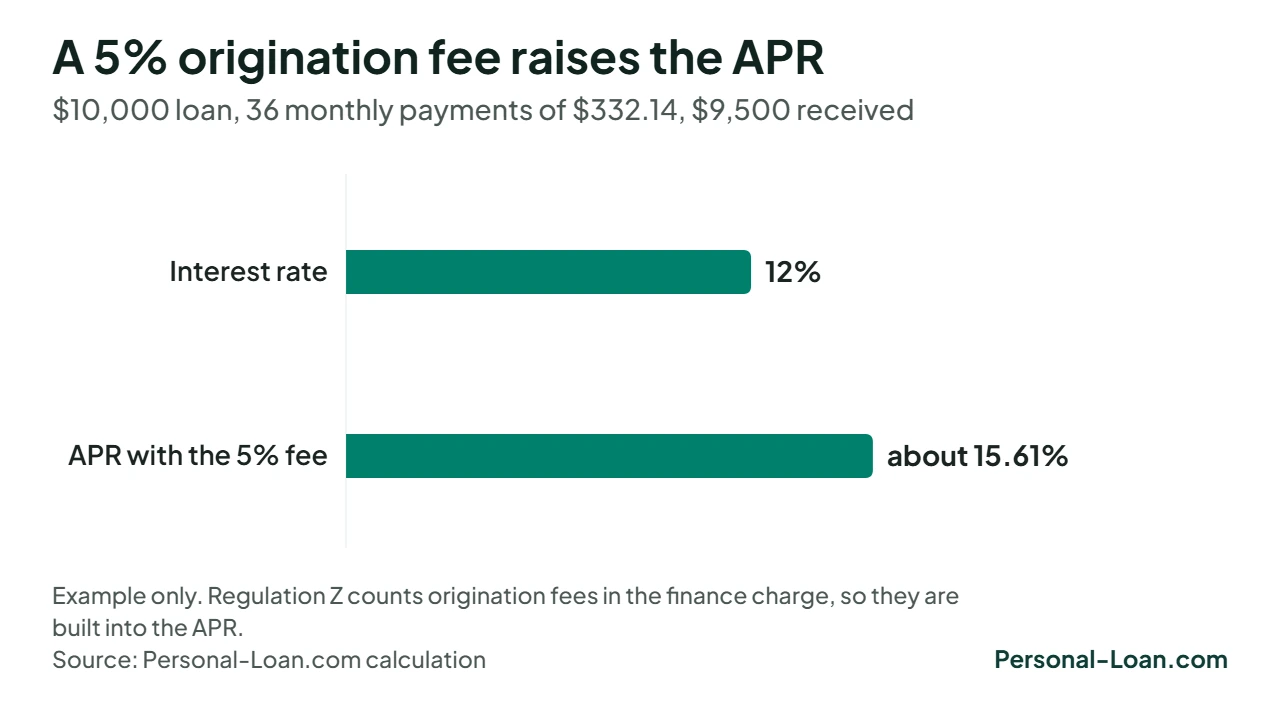
- An origination fee is a one-time charge for making the loan, usually a percentage of the loan amount that is deducted from the money you receive. Experian (September 25, 2026) says origination fees can range from 1% to 10% of the loan amount, and because Regulation Z treats them as part of the finance charge, they are included in the APR. Example only: with a 5% fee on a $10,000 loan at a 12% interest rate, you receive $9,500 and make 36 monthly payments of $332.14, which works out to an APR of about 15.61%.
P
- Payday alternative loan (PAL)
- A payday alternative loan (PAL) is a small-dollar loan from a federal credit union, made under NCUA rules and priced well below a typical payday loan. The NCUA allows PALs II loans of up to $2,000 with terms of one to 12 months, and federal credit unions may charge up to 28% on PALs.
- Payday loan
- A payday loan is, in the CFPB’s words, “usually a short-term, high-cost loan, generally for $500 or less, that is typically due on your next payday.” A personal installment loan, by contrast, is repaid in several payments over months or years.
- Payment history
- Payment history is the record of whether you have paid your accounts on time, and it is the largest factor in both main scoring models. It makes up 35% of a FICO Score, according to FICO, and 41% of a VantageScore 4.0 score, according to VantageScore.
- Payment-to-income ratio (PTI)
- Payment-to-income ratio (PTI) is the payment on one loan divided by your gross monthly income. Example only: a $196.16 payment (from $5,000 repaid over 36 months at 24% APR) on $4,000 of monthly income is a PTI of about 4.9%. Some lenders look at PTI alongside DTI to judge whether one new payment is affordable; federal rules don’t set a single definition for personal loans.
- Personal loan
- A personal loan is money you borrow from a bank, credit union or finance company and repay in fixed installments, often with no collateral. The CFPB says lenders look at your credit history, income and debts, the loan amount and length, and the rates your state permits. See how personal loans work.
- Preapproval
- Preapproval is a lender’s conditional decision, made after a closer look at your credit and finances, that you are likely to qualify on stated terms. Experian (September 25, 2026) says preapproval typically involves a hard inquiry and may include a review of income and bank statements, and that neither preapproval nor prequalification guarantees you’ll qualify. No federal rule defines either term for personal loans, and some lenders use the two interchangeably, so ask which kind of credit check a lender will run.
- Precomputed interest (Rule of 78s)
- Precomputed interest is interest worked out for the whole term up front and built into the loan, unlike simple interest, which is charged on the declining balance. Paying a precomputed loan off early may save less, especially under the “Rule of 78s” refund method. Federal law (15 U.S.C. 1615) requires a prompt refund of unearned interest when you pay off early and bans the Rule of 78s on consumer loans with terms over 61 months.
- Prepayment penalty
- A prepayment penalty is a fee for paying off all or part of a loan early. Regulation Z requires the lender to tell you, before you sign, whether it may charge one. Not every lender does, so check the Truth in Lending disclosure.
- Prequalification
- Prequalification is a quick estimate of whether you might qualify and at what rate, based on basic information you provide. Experian says it typically uses a soft inquiry, and FICO says soft inquiries don’t affect FICO Scores. A prequalified rate is only an estimate: the final rate comes after a formal application, which usually involves a hard inquiry.
- Principal
- Principal is the amount you borrow, or the part of it you still owe, not counting interest or fees. Each payment cuts the principal by whatever is left after that month’s interest (see amortization).
R
- Rate cap (usury limit)
- A rate cap is the highest interest rate or APR a state allows a lender to charge, and it often depends on the loan size and the lender’s license. In its December 19, 2025 report, the National Consumer Law Center (NCLC) found that for a $2,000, two-year loan, 43 states plus DC cap the APR, with a median cap of 34%. Caps generally bind state-licensed lenders, while banks can use rate exportation (see personal loan rate caps by state).
- Rate exportation
- Rate exportation lets a bank charge borrowers in other states the interest rate allowed in the state where the bank is located. Federal law gives this power to national banks (12 U.S.C. 85) and to FDIC-insured state-chartered banks (12 U.S.C. 1831d), which is why a bank loan can carry an APR above your state’s cap. Federal law also lets a state opt out of the state-bank rule, so check which lender is named on your loan agreement.
- Rate shopping
- Rate shopping is comparing offers from several lenders before you pick one. Prequalification with a soft inquiry lets you compare estimated rates without affecting your score. Each formal application can add a hard inquiry, so narrow your list before you apply.
- Refinancing
- Refinancing is replacing an existing loan with a new one, usually to get a lower rate, a lower payment or a different term. Count any new origination fee. A longer term can raise your total interest even at a lower rate.
- Regulation Z
- Regulation Z (12 CFR part 1026) is the CFPB rule that implements the Truth in Lending Act. It defines the APR and the finance charge and sets what lenders must disclose before you sign. It also applies to anyone who advertises credit, not only lenders: an ad that mentions a payment amount, a number of payments or a finance charge must also give the APR and the full repayment terms.
- Returned payment fee
- A returned payment fee, sometimes called an NSF fee, is a charge for a payment that bounces because your account is short of funds or the payment is rejected. Your bank may charge its own fee on top. The loan agreement lists the amount, and state law may limit it.
- Revolving credit
- Revolving credit is an account you can borrow from again and again up to a limit, such as a credit card or a line of credit, and the payment changes as your balance does. Regulation Z calls it open-end credit. A personal installment loan is closed-end credit.
- Right of rescission
- The right of rescission is the right to cancel certain loans within three business days after signing. Under Regulation Z it applies to credit secured by your principal dwelling, such as many home equity loans. It does not apply to unsecured personal loans, so read the terms before you sign.
- Risk-based pricing notice
- A risk-based pricing notice tells you that a lender used your credit report to offer you terms materially less favorable than the best terms it gives a substantial share of its customers. Regulation V (12 CFR 1022.72) requires it, though the rule lets lenders give a credit score disclosure instead, which shows your score and how it compares with other consumers’ scores.
S
- Secured loan
- A secured loan is a loan backed by collateral that the lender can take if you don’t repay. A secured personal loan may use a savings account, a certificate of deposit or a car title. It can be cheaper or easier to qualify for, but you put the asset at risk.
- Servicemembers Civil Relief Act (SCRA)
- The Servicemembers Civil Relief Act (SCRA) is a federal law that, among other protections, caps interest at 6% a year during military service on debts a servicemember took on before entering service (50 U.S.C. 3937). Interest above 6% is forgiven, not postponed. For credit taken out while on active duty, see the Military Lending Act.
- Simple interest
- Simple interest is interest charged only on the unpaid principal, never on interest already charged. On a simple-interest personal loan, interest typically builds daily, so paying early or paying extra cuts the total interest and paying late raises it.
- Soft inquiry
- A soft inquiry is a credit check that doesn’t affect your credit score, such as checking your own report or a lender’s prequalification check. FICO says soft inquiries don’t affect FICO Scores. Ask a lender which type of check it will run before you give consent.
- Statute of limitations (time-barred debt)
- The statute of limitations on a debt is the period during which a creditor or collector can sue you to collect it; once it runs out, the debt is “time-barred.” The CFPB says most states set limits of three to six years, and that a partial payment or acknowledging the debt may restart the clock. Regulation F bars debt collectors from suing or threatening to sue over a time-barred debt, although they can still ask you to pay by letter or phone.
T
- Term (loan term)
- The term is how long you have to repay the loan, usually stated in months. A longer term means a lower monthly payment and more total interest (see monthly payment). When you compare offers, compare them at the same term.
- Thin credit file
- A thin credit file is a credit report with few accounts or a short history, which can leave some scoring models without enough data to produce a score. Lenders may decline you or charge more. A co-signer, a credit union or a credit-builder loan can help.
- Total cost of the loan
- The total cost of the loan is everything you pay beyond the money you receive: all the interest plus all the fees. On the Truth in Lending disclosure that figure is the finance charge, and the total of payments shows principal and finance charge together. Example only: $5,000 repaid in 36 monthly payments of $196.16 at 24% APR costs $2,061.91 in interest, for a total of payments of $7,061.91; run your own numbers in the personal loan calculator.
- Total of payments
- The total of payments is what you will have paid once you make every scheduled payment. Regulation Z requires lenders to disclose it with a description such as “the amount you will have paid when you have made all scheduled payments.”
- Truth in Lending Act (TILA)
- The Truth in Lending Act (TILA) is the federal law that requires lenders to disclose the cost of credit in a standard way so you can compare offers. The CFPB implements it through Regulation Z.
- Truth in Lending disclosure
- A Truth in Lending disclosure is the standard statement of a loan’s cost that the lender must give you before you sign. For a closed-end personal loan, Regulation Z requires it to show the amount financed, finance charge, APR, payment schedule and total of payments, and to say whether there is a prepayment penalty, a late charge or a security interest. Check it against what you were quoted before you sign.

U
- Underwriting
- Underwriting is the lender’s review of your application to decide whether to lend and on what terms. According to the CFPB, lenders typically weigh your credit history, income and existing debts, the loan amount and length, and the rates your state allows.
- Unsecured loan
- An unsecured loan is a loan with no collateral, approved on the strength of your credit and income. Many personal loans are unsecured. The lender can’t simply take your property if you default, though it can sue, and rates may be higher than on a secured loan.
- Usury
- Usury is charging more interest than the law allows. Each state sets its own limits and exceptions, and for licensed installment lenders the limit is usually the state’s rate cap. NCLC’s 2025 report found that for a $2,000 loan, Alabama, Idaho, South Carolina, Utah and Wisconsin rely only on unconscionability (a doctrine that lets courts refuse to enforce grossly unfair terms), and Delaware and Missouri have no cap.
V
- Variable rate
- A variable rate is an interest rate that can change during the loan, usually because it is tied to an index such as the prime rate. Regulation Z requires the lender to disclose a variable-rate feature before you sign. Variable rates are more common on lines of credit than on personal installment loans.
- VantageScore
- VantageScore is a credit scoring model that works with data from all three nationwide bureaus, and versions 3.0 and 4.0 run from 300 to 850. VantageScore says version 4.0 weights payment history at 41%, depth of credit at 20%, credit utilization at 20%, recent credit at 11%, balances at 6% and available credit at 2%. Experian lists its bands as subprime (300-600), near prime (601-660), prime (661-780) and super prime (781-850).
Personal loan terms FAQs
What is the difference between APR and interest rate?
The interest rate is the yearly charge for borrowing the principal, while the APR adds most lender fees, such as an origination fee, and states the total as a yearly rate. Regulation Z sets how the APR is calculated, which makes it the better number for comparing offers with the same term. On a loan with no fees, the two can be almost the same.
What is the difference between prequalified and preapproved?
Prequalification is a quick estimate based on basic information and usually uses a soft credit inquiry, while preapproval is a closer review that typically involves a hard inquiry. Experian says neither one guarantees a loan. No federal rule defines either term for personal loans, so ask each lender which credit check it runs.
Does checking personal loan rates hurt my credit score?
Checking rates through prequalification with a soft inquiry does not affect your FICO Scores, according to FICO. A formal application usually triggers a hard inquiry, which FICO says takes less than five points off most people’s scores and affects them for a year. Lenders may check your credit when you send them a request, so ask which type of check applies.
Is the origination fee included in the APR?
Yes, Regulation Z counts loan fees such as origination fees as part of the finance charge, so they are built into the APR. That is why a 36-month loan with a 12% interest rate and a 5% fee deducted works out to an APR of about 15.6% (example only).
Updated November 2026. This page is general information, not financial or legal advice.